Missing the Mark

More AiG reading, in response to yesterday’s celebrations of Charles Darwin’s 206th birthday, and I find myself again reading too much into things and then writing stuff about those thinkings.

You see, in response to the scientific world celebrating the venerable scientist’s birthday, AiG published this article, declaring that February 12th be celebrated by the Church as Darwin was Wrong Day. Never mind the fact that I can find nothing of the Biblical teachings of love and tolerance in this proclamation from the great prophet Ken Ham (PBUH), the article itself makes so many cringe-worthy statements that it actually blew my mind a little. There were gems like “The evolutionary worldview is an attempt to explain the universe and life without God.” I think that misses the mark; it assumes that evolution started with the intent to write God out of science, which is just patently untrue; evolution was stumbled upon while trying to understand how the world works, and understand our place in it. The fact that we were looking and could not find God is not our problem, because our goal never had the word God in it in the positive or negative. How about the fact that we understand things like antibiotic resistant bacteria through the lens of evolution? I know it is your opinion, theoretical young earth creationist, that genetic information cannot be created — so how is it, then, that MRSA has become so resistant. Did it always have the ability to resist bacteria? Did it just have to believe in itself? Is it the plucky nerd in the 1980s romantic comedy that science clearly represents? Or did its actual genetic makeup change to allow it to resist the killing influence of traditional antibiotics?

Accidental self awareness is one of my favorite forms of comedy, and this statement made me laugh ruefully: “Sadly, many Christians buy into this religion and simply squeeze God into the gaps somewhere.” As though you don’t squeeze God into the gaps everywhere? When science says it doesn’t know something yet, you completely ignore the word “yet” and scream victory from the top of mountains, declaring that science doesn’t know so God did it. And that doesn’t constitute using God as some kind of mortar in the brick wall of knowledge? (If that metaphor missed the mark, as many of my own tend to, I was using the gaps between bricks as the gaps God fills.)

I do appreciate the journalistic integrity in this sentence, as the word “known” could have been left out to solidify his beliefs, but it plays nicely into my own narrative as written: “There are no known exceptions to this law.” The law in question is the law of Biogenesis, where life comes from; and they claim that life and only come from life. But as I’ve mentioned, we haven’t found the way life originates from non-life conclusively yet, though we are making strides. Richard Dawkins has a very good theory, I think, it’s just too bad we don’t live for 100,000 years to test it — we may never see it happen in nature or in a lab, but that doesn’t mean we shouldn’t look.

“Yet, according to evolution, the law of biogenesis had to have been broken at least once when the first single-celled life emerged from non-living matter.” Therein lies the rub, friend; how many particles are there in the earth? How many atoms, how many molecules, how many bacteria — and, forgive me for my limited ability to observe, but you’d be hard pressed to watch every molecule in the Earth all the time every day. Who is to say that there are not new forms of single-celled organisms popping up in the deepest craters of the Earth every day? Just because we haven’t seen it yet doesn’t mean it can’t happen, and given the statistical numbers at play here, the chance of it happening could be very remote, and yet the law of large numbers need only account for one of them.

I don’t want to spend a whole paragraph on this one: “There never was a time when life arose from non-life because life came directly from the Life-giver, our Creator God, just as it says in Genesis. And that’s what observational science confirms!” Where did God come from? What evidence have you that He Himself never had a beginning. I mean, an infinite life form raises some serious concerns, like what was He doing before creation? Why did He choose to Create when He did? He was just randomly strolling through chaos for infinity quadrillion years, then created us?

“There is no known mechanism that can change one kind of animal into a totally different kind.” That one is false, and can be proven so using their own definition of kind without a great effort. This article explains it more thoroughly than I could, but suffice it to say that if a kind is an animal that can interbreed, then we have observed kinds changing into other kinds, and it happens all the time. Long story short, while a reptile may still be a reptile, it cannot breed with other reptiles that its parents can breed with, therefore it is a different kind. Perhaps I have misunderstood your definition of “kinds”, but I was under the impression that “kinds” can always interbreed.

“However, most mutations are negative or neutral to the organism.” This author is fighting their own conscience, I fear. Read that sentence over and over again, it is the greatest he has written, and possibly the most accidental. “Most”. That single word changes the sentence, ruins the picture, spills ink all over it. His admission that “most” mutations are neutral or negative leaves the door wide open for those very few, those rare, those amazing mutations that allow evolution to function. Yes, 99,999,999,999/100,000,000,000 mutations may be bad — but given the population of our wonderful planet, that still leaves the door wide open for beneficial mutations to function on an evolutionary level. Even in your 6,000 year old Earth, denying evolution based on the “most mutations are bad” argument is incredibly facile.

Now, this quote is going to be a long one, but bear with me for just a moment. “Evolution predicts that the human body should be filled with vestigial organs. These are supposed to be largely useless leftovers from our evolutionary past that have either lost their function or have reduced functionality. Over the years, around 180 organs have been labelled as vestigial, such as our appendix, coccyx, and pineal gland. This label hindered research into the actual function of these organs because, well, why bother researching a leftover of evolution?” (Emphasis mine)

That is the ultimate argument for our side, and I have no idea what level of cognitive dissonance allowed the writer to make that argument in favor of the YEC side. Their entire stance is predicated upon the idea that “The Earth is 6,000 years old, so why would you even want to research ways to tell its age?” That is the exact argument they just accused scientists of making, and then they made it for their side and I don’t even wblwblwblbwlwblbwlbwlwb. Woah, sorry. My brain went into a reboot condition there, the amount of willpower it takes to hold up that level of cognitive dissonance doesn’t fit into my mind’s calculation space.

Now I’ll give you a pair of quotes from that article, make of them what you will.

First: “God created the original kinds in Genesis and placed within each one the genetic information needed to survive in a changing environment. God knew that the Fall and the earth-changing global Flood of Noah’s day would come and, in His wisdom, He designed organisms with the genetic variability to be able to survive.”

Second: “Of course, because of the Curse and the Fall, things do not work quite the way God designed them to.”

Allow me to make one point of my own in this rebuttal, if you would indulge me. How do you account for things such as Cancer and Down’s Syndrome, in a world crafted by your loving God? These come not from some outside influence, not from some sin, but from our own genetics rebelling against us. Even accounting for mutations, why does the genetic information required to create cancer exist, if no new information can be generated by mutations? Are you saying God wrote cancer into our DNA?

Just a thought.
Shortsighted Science

Due to my proximity with at least one other person crazier than I am, I have started to read the subtext into what a lot of people say. Honestly, it may not be entirely fair of me to do so; inferring subtext is more of an art than it is a science, but when you stop scraping the surface and actually dig into what people say, you can find some surprising things. I was reading AiG again (SURPRISE!) and something clicked into my head that was always there, but that I personally had not considered.

AiG likes to press the issue of Historical versus Observational science like a dealer pushes his best product at twice its going price. I know this has never sat well with scientists, a false dichotomy that lowers the level of discourse in the scientific field, but in a country where some 47% of the populace responds that they believe the universe is at most 10,000 years old we do have to address their concerns head on, or allow them to swell their numbers based on a tacit assumption that our lack of fighting back means we can’t. Ah, but there’s another rub, isn’t there? Very intelligent, rational people are like “Ignore them and walk away; they’ll burn themselves out.” What we have seen based on that is a groundswell of support for their ideas, and I think people like Bill Nye, who have taken the fight back to them, are becoming more in the right. Even the famous quote “If I were to debate you, it would look great on your CV, not so much on mine,” is adding to the problem–because they will go to a populace who do not follow the behind the scenes of these things, and tell them that “Oh, these atheists are afraid to debate us because they know we’d win.”

Read the above, and try to tell me that isn’t a grade school logic… And yet here we are. So let’s talk about historical and observational science. What I seem to understand, reading young earth arguments, is that they believe “historical science” (herein referred to as “science” for obvious reasons) is hand waving and sleight of hand, and that we cannot test these things, and that they have no predictive power, and that they are functionally useless lies. I think that is an accurate encapsulation, anyway; my response will be built upon this framework, anyway.

Geology may seem like low hanging fruit, but let’s start there; certainly geological aging techniques and studies are a huge point of contention for the YEC, so let’s talk about their short shortsightedness, and see how they draw their lines in the sand. No one will argue the study of plate tectonics, nor their application in predicting areas prone to earthquakes; certainly, if they did, they would be the only ones surprised when an earthquake hits San Francisco. Now, here’s the rub; the study of plate tectonics have allowed us to give a general idea of the age of the Earth based on the movement of the continents and on the geographic formations based on (again) the movement of tectonic plates (Reference). These aren’t perfect numbers, but they allow us to make predictions (such as the formation of mountain ranges, changes in the sea level of land masses, movement speed of continents, etc). If our future predictions are correct, then we can make inferences on the past. Are these inferences absolutely, definitely correct? No, nothing is, but we make statistical analyses, and use other methods of science to form a picture.

Given that we use the same science to predict future movements and general age of the earth, young earth geologists have to draw a line in the sand. This line is fairly arbitrary, and I would call it very shortsighted; we can use it to predict, and it will show us an accurate picture back 6000 years without breaking a sweat. It will give us a picture of what things looked like 100,000 years ago, 1,000,000 years ago, 65,000,000 years ago… All using the exact same system. But here’s the funny thing; the YEC geologist will say “Yeah, geology is accurate as to what the Earth would have looked like 6,000 years ago, but taking it any further than that is BLASPHEMY (for some reason),” despite the fact that it uses the exact same system. In fact, their arbitrary line in the sand may actually be even more recent, as recent as 4400 years ago — since the face of the Earth was catastrophically rearranged at that time (even though we have unbroken histories of… Say… The Egyptians right through that time…).

So how does your historical science and observational science differ, in this case? We are using the same math to predict forward as we are to go backwards, so why does the math just magically stop working some arbitrary number of years ago?

There is also the much more egregious issue in the field of cosmology, for which the YEC cannot even supply any scientific reason for their belief in certain things. For example, the speed of light is universally accepted to be the rate limiting factor in all cosmological events and transfer of information, and based on that we can look into the night sky and see back further than 6000 years with our naked eye. Give me a weak telescope and I can see one or two billion years into the past, and easily make predictions based on that (This is one of my favorites). Again, we have to draw a line in the sand, but while the YEC will have spurious scientific reasons for doing so in respect to geology (respect? Pah, poor choice of words) they don’t even have spurious reasons in the cosmological field. You don’t have a flood story that would have thrown the universe around, and the Hubble UDF (Warning: that link takes you to the full size, 60MB picture. You may need a few minutes while it loads, and to prepare to weep at the beauty of space) makes it easy enough to see that there is nothing that would happen on an Earth-level scale that could account for what we see.

Now, as I’ve pointed out, we make observational predictions using this data; the Milky Way-Andromeda collision. So how is it that we have untestable historical something something not science here? Well, this is where we see the true hole, the true flaw in the reasoning; when asked about it, YECs reply simply with “God formed the Galaxies with their light en route to Earth. Duh.” This is the lowest level of special pleading, a type of special pleading that raises no evidence, and is in absolutely no way testable. I mean, I can’t… I can’t understand how strong the cognitive dissonance is, where you can say “You make claims that aren’t testable! But our God made the universe with light en route to Earth that just happens to align with your theories of how old the universe is. Which is totally testable, somehow?”

By that very logic, everything could have come into existence 5 seconds ago, with all the everything in place and memories fabricated, and God just wants to watch us fight for his own amusement. In any case, why would you God who wants everyone to realize that He exists and worship Him put so much evidence in place that points to an old universe? Why would he have put the light en route? Just think of the beauty of the sky had he not; every day, every year, every decade, the night sky would be lighting up for our wonder and amazement. We would see stars seemingly wink into existence, if the universe was 6000 years old and light only started to travel when it was created. I mean, Adam would have had a very boring universe for the first few years, but there are stars only four years away from us. Just imagine the wonder he could have felt, had he seen the very first star wink into existence one night.

In any case, we can successfully predict the future to an extent, and use that confidence to successfully predict the past. Your arbitrary sand line, without so much as any support outside of special pleading, does not help anyone.

Now, let’s talk about your observational/operational science. You rightly say that certain sciences do not rely on other branches of science to function, and it is by this that creation scientists such as Newton made their strides, or by this that the MRI was invented. I won’t take that from you, I have never been one to say that no creationist can do science; perhaps it is even admirable what you have accomplished despite your hamstring in certain fields. But again, we end up with strange lines drawn arbitrarily in the sand. For example, we’ll call translation a science for the purposes of this; certainly hermeneutics is a scientific field (basically the science of understanding what people with old languages meant to say), but why is it observational rather than historical in your mind? I mean, you weren’t there to see the original Hebrew scriptures written, it is only through non repeatable tests that you are able to guess at their meaning in English. Certainly, that scientific field does not let us make predictions about the future. So why does that science count?

There is another odd thing about observational and historical science in your world. We don’t try to discover the age of the Earth specifically to make you angry; we do so to test our scientific theories, see how well they can predict things, refine them, and use them to understand what is coming in the future. When you tell us that you have discovered through Geology that the Earth is 6000 years old, what does that help us? It seems almost like you don’t want to prove anything except that you believe science is wrong, which, as per the title of this post, seems shortsighted. We don’t do science out of some arbitrary feeling of wanting to know, we do science so that we can understand and predict the universe we live in, thus allowing us to better prepare ourselves for what is coming. Does shouting that the world is 6000 years old prepare us for discovering an asteroid on a collision course with Earth? Orbital mechanics also allow us to date certain objects; why do you want to shout that they are only valid up until your arbitrary 6000 year date? Even if you were to use orbital mechanics to discover said oncoming asteroid, how do you justify the fact that this asteroid’s theoretical trajectory could place its origin in the Mars/Jupiter asteroid belt some 150,000 years ago? (I chose those arbitrary numbers to prove a point; I am afraid I am not astrophysicist). Perhaps, tracing the orbit of said body of mass we find that 6000 years ago it was in the middle of nowhere, on a collision course to Earth. Did God create that giant space rock at the beginning, on a path to Earth, just to mess with us? (And, incidentally, ruin our day?)

Please remember, when you are trying to argue historical science, that science goes forwards and backwards, and that historical science (which is a distinction most scientists would not make) is really just a branch of observational science that looks backwards instead of forwards. If you think we can look forwards with observational science, at what hasn’t happened yet, what is it that makes it so hard for you to believe that we can’t look at what has happened? We have even more evidence for what has happened than we do for what will happen, so I cannot resolve your cognitive dissonance.

And here we are, with me ranting about it.

Where it all Started

I am going to preface this post by saying I need to give myself a self-imposed ban from AiG. I mean, I know there are people who like it when I write things (at least, they tell me they do…), so maybe I should go back more often–but as it stands, every post I read sparks something that I feel I need to write down. And then I make multiple posts in a single day, and there is no stemming the tide, and eventually people decide I am too wordy and never come back.

That is a concern for another day; my concern right now is the true root of the issue, the point that Ken Ham has tried to hammer home with the force of one thousand suns, and which seems to slide by so many people unnoticed. Certainly, it slid by me unnoticed; I’ve written about this very issue, but somehow missed the point over and over and over again. Certainly, it is an application of Occam’s actual razor; not the popular iteration (easiest solution is best solution), as that iteration is: a) not Occam’s razor, and b) leads to very incorrect application.

Occam’s razor states that among competing interpretations of the same data, the one that makes the fewest assumptions should be taken as correct. Now, the razor is non-binding, meaning a more complicated solution could be correct, but let’s grab this idea and run with it for a second. In the article I was reading, the writer makes reference to Bill Nye’s assumptions muddying the waters of good science. So you know what? Let’s step back and think about some assumptions.

I’d like to start with the very beginning of the universe. How did the universe start? Well, we have the two primary competing theories, that the universe was created, pitted against the idea of the Big Bang.

What are the assumptions underlying each? Well, we can start with offsetting assumptions; the Christian will assume a God, and the scientist will assume the matter involved in the Big Bang. No points to either side, there. We move along, the YEC assumes that the universe had very different laws in the first six days of creation; this can be inferred easily by the fact that plant life was created before the Sun; you have to assume that plants had some system that allowed them to live without sunlight, or that God is in fact a leading source of your daily UV intake (something that seems silly to me, but whatever). What about the assumption that physics somehow supported a Hydrosphere above our current atmosphere that contained all of the water that now covers the Earth? We also assume that modern biology (less than 6,000 years old) somehow survived the pressure of the atmosphere getting cut not just in half, but probably more than that. Those are some large assumptions.

Obviously, someone may come back saying that the Big Bang is an assumption that things happened and then stuff existed, but I think you are making an error of judgment in making that call. We didn’t start from the assumption that the big bang existed, we took the relative velocities of hundreds of thousands of galaxies (more than that now, but we are talking the early days of the theory), and performed a ton of mathematical equations on them. Doing the math, then applying it in reverse with respect to time, we end up at a singularity.

“Ah!” You may counter. “But what about the geologists who assume an old universe?” Thank you for conveniently bringing that up right when I needed it, theoretical reader who doesn’t exist probably!

They don’t assume an old universe; they defer to an expert. To clarify, any geologist could go to a cosmologist, and ask to see the math that indicates the universe is old, and get an educated answer.

“AHA!” You reply with great vehemence. “How is that different from me deferring to God as an expert on all things?”

Deferring to God (or the Bible, but there’s another assumption; you are assuming the truth of a book that claims it is true, a bit of semi-circular reasoning I discussed with fervor yesterday) is not like a geologist deferring to a cosmologist. A cosmologist can show their work; the answer provided by the Bible doesn’t show work, it doesn’t explain the physics. Does the Bible explain how the plants lived without the Sun? No, we have to make that assumption. Aw man, assumptions are piling up on the YEC side.

Now, we do the math in reverse until we arrive very near to the singularity. We aren’t there yet, don’t have all of the answers we need, but do you know what? We don’t assume the answer. Tomorrow, we may find some evidence that proves us wrong. But do you know what? You know what is really funny? We make so many fewer assumptions, despite the YEC tendency to assume wild amounts of things. How about some other assumptions that underlie the 6000 year cosmology?

Assumption: God is infallible.
Assumption: The Bible is infallible.
Assumption: God exists outside of time.
Assumption: The rules of science change to fit your view.
Assumption: Humans wrote down the Bible correctly.
Assumption: Translators made no errors. (We can pretty much objectively prove this false, and easily so in the case of the KJV)

Oh, I am not going to get on an arrogant horse and say that science makes no assumptions. We just make fewer. For example, in the Big Bang example I’ve been using, I have to rely on math. We have to assume 1+1=2, for without the ground work what good does it do us? But beyond that, all math is basically a function of that truth. We don’t make assumptions regarding the data, we make analyses of the data; analyses that we do not necessarily posit to be infallible, but which work best with what we know.

So try to find assumptions. The age of the Earth? While this is built upon the pillar of an Old Universe cosmology, it does not assume an Old Earth. The better part is that it doesn’t assume a lot of science you seem to think we assume; do we assume carbon dating works? No, we match carbon dating to things that are easier to quantify. Things like tree rings. “Ah, but you assume that tree rings happen once per year! AHA!” Not necessarily, friend; we know that there are certain rare cases where tree rings form at different rates, but they are just that–rare. But even then, we don’t rely on tree rings; we also correlate those to ice layers. “AHA! But you assume ice layers form at regular rates!” I wish you’d stop interrupting me like that, reader, it is slowing us down. Ice layers don’t necessarily form at rates of one per year either, but even in cases where they form faster, we can tell which year they formed in.

“HOW YOU DO DAT?!”

Reader, I feel like you are getting petulant. Well, it should come as no surprise that temperatures are changing on the planet, even if you don’t believe humans are doing it, and with that (correlating data, not causal data) the CO2 levels are changing. The atmosphere plays a part in the composition of ice, the carbon levels in the ice, for example. So if five ice layers form in a year, but all have the exact (p<.001, we’ll say) same levels of carbon in them, we can infer that they happened in the same year. But we don’t rely on that, assume that, either.

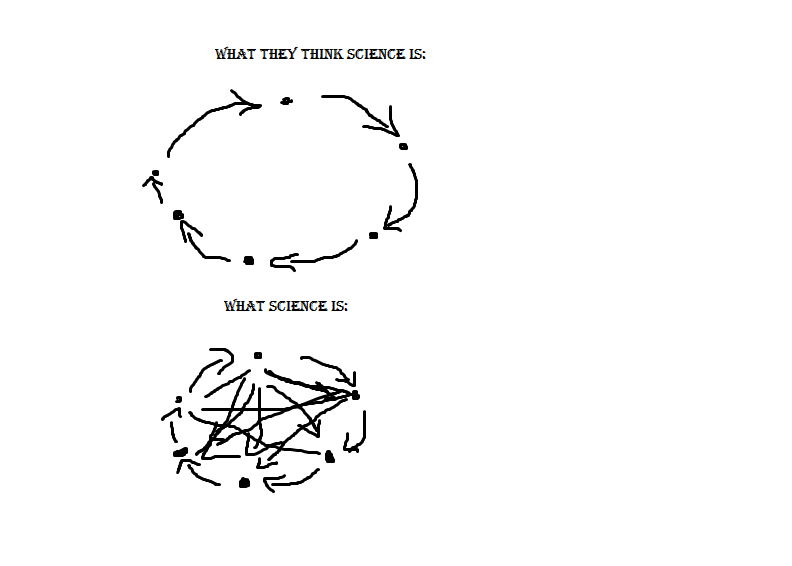
What we have done, though, is tied these pieces of evidence into a giant circle. It is a piece of circular reasoning, of course; we know the age based on tree rings because that lines up with the age based on ice cores because that lines up with carbon dating because that lines up with coral deposits because that lines up with ice ages because that lines up with crust deposits moved by glaciation because those line up with tree rings. The YEC strategy seems to be to knock out one pillar, and assume the whole structure will come crashing down. But you know what? This calls for my trademark MSPaint skills.

SCIENCE!

SCIENCE!

They seem to believe that if they remove one element, it will all fall apart, but that is clearly not the case. If you remove one, or two, there are still one hundred pieces left, held up by the other 99 pieces that all paint the same picture.

We don’t make the assumption that these are all correct, but I will give you that we assume that at least one of the million pieces of the puzzle is correct. If one is correct, then we have an old earth.

The issue is that you only have one piece of the puzzle, upon which everything relies. If we prove that one piece wrong, that one single piece, what will you fall back on? Keep attacking our science with your arguments, that is OK; science gets stronger as we learn more, and if you find a true flaw science will grow stronger for repairing it.

The problem is for every discovery we make, there are fewer pieces of the Bible to lean on. The issue is your “rock solid” stance that the Bible should never change; as it crumbles below you, you stand firm, until the day it is gone and your world falls apart — and I believe that day will come.

If the foundations we build upon crumble, we either repair them or move. There have been thousands of theories and hypothesis that have been jettisoned for their incorrectness. There have been thousands of flaws pointed out that took brand new branches of math and science to fill. We could not describe the universe without calculus, and before calculus existed we did not understand — but instead of being satisfied that “God did it,” Isaac Newton discovered an entirely new form of math to describe the solar system, and new discoveries are made every day, hundreds of years later.

Isaac Newton didn’t have all the answers, though; famously, when considering the Solar System, he could not make the math work, and even that great mind said “Well, God did it!” But minds that followed, minds that stood on the shoulders of that giant, discovered greater shoots off of that great branch of science that allowed us to describe the universe better.

Do we know what happened to start the Big Bang? No. Do we know the physics of the Big Bang? No.

But we stand on the shoulders of the greatest minds in history, and we move closer to that knowledge every day. Your standing there, shouting “We have the answer, stop looking!” will put you on the wrong side of history.

Your religion may never put you on the wrong side of history, and I think it is incredibly important to mention that. Isaac Newton was a religious man, wildly so — he was an alchemist, and that turned out to be wildly incorrect (and probably shortened his life), but he is on the right side of history and science, while still being religious.

So take your religion in hand, because sitting down and screaming that you won’t believe science will make you look, in historical retrospect, exactly like a child throwing a tantrum in a public space.

You can believe as you wish, but stop making one thousand assumptions, then accusing science of making a single assumption. I think there was a Bible verse that said that exact thing in almost the same words. 

Slightly too Complicated for Children

More reading down the anti-science hole, I came across a blog post by Ken Ham (PBUH), prophet of the Young Earth Movement. I didn’t find it overly offensive for the most part, it mostly was just him reiterating the Young Earth Script–but eventually I came across a line that kind of caught my attention: “… Children can easily see that complicated life can’t be built up on the basis of mistakes…”  Yes, but can they see why kids love the taste of Cinnamon Toast Crunch?!

The reason that line jumped out at me is that it is so disingenuous it hurts, as though Ken Ham is trying to imply that all complicated science should be understood by children. I would argue this isn’t the case. An example, perhaps: Spacex is launching a rocket with a probe on it, and I am sure kids don’t understand the physics that go into that. You know what that means, right? It means God did it. God launched that rocket. The thousands upon thousands of man hours that went into it? NASA just made those man hours up. Kids could launch a rocket, if they just something something GOD.

Or how about the drastic oversimplification of the theory of evolution? I know how they do love to stand on the crutches of “Observational Science,” but there are some deep flaws in their idea of what constitutes this version of science that they themselves created. First, they seem to be of the mind that since we have never seen it, it can’t happen. Life from non-life? That’s crazy. Life from the word of the mouth of an eternal being? Totally a more viable solution. Again, though, the subtext is important; “We have the answer so YOU HAVE TO STOP LOOKING FOR AN ANSWER.”

They are right, we haven’t managed to create life in the lab yet. We don’t necessarily know how it started. But ignorance is both the best friend of science, and its worst enemy; ignorance lets us know where we have to look to find new knowledge, but it is also something to be eradicated over time. Science has been a powerful force for only 150 years; in the grand scheme of cosmic evolution, I would need to invoke a LOT of leading zeroes to give you the percentage of history that covers. Even in your 6000 year cosmology, we have only really been using science (as we’d understand it in the modern era) for only 2.5% of history, and you expect us to have all of the answers? And of course, if we admit even once that we don’t have the answer, you claim some sort of victory, as though the sum of all human discourse has all of the maturity and gravity of some middle school playground.

The funny thing, the thing that makes me laugh, is the petulance on display. If they would just sit back and let us “do science,” as the common parlance goes, maybe we’d discover that they were right all along. Obviously, I think that is (at best) very unlikely, but if they are so overwhelmingly confident, why do they act like they are being pushed around so badly? Theirs is the type of confidence (arrogance) that should be able to step aside, a knowing glint in their eye, as the children find all the answers on their own. Surely, with that level of confidence, they could trust that we would all arrive at their conclusion eventually.

And there’s the rub, there’s the whole thing, they know (deep in their hearts) that science is coming closer and closer, inexorably, from invalidating their world view. Of course, the confidence they have will not be pricked by evidence (that is already clear), and they will believe as they do in full opposition of irrefutable evidence. That’s ok, I just think it is ironically hilarious that I could so easily employ a simple word replace and make Romans 1:18-21 say exactly what is happening.

18 The wrath of [science] is being revealed from [humans] against all the [ignorance] of people, who suppress the truth by their [ignorance], 19 since what may be known about [science] is plain to them, because [humans have] made it plain to them. 20 For since the creation of the world [science has] been clearly seen, being understood from what has been made, so that people are without excuse.

You know what? I actually like that set of verses. I might actually print them off, because I think they say a lot about the human condition, our ability to stand by our beliefs in the face of evidence, of statistics, of physics, of history. I am not immune to it, though I do try to step back and validate my beliefs regularly. Like any human, I know I fail to recognize all of my failings, but dammit, I give it a strong effort.

Young Earth Creationists do not give an effort to find their failings, but that is not to take away from the fact that they put a huge amount of effort; the amount of man hours they put into creation science is stunning… And almost admirable. The only problem is that the only way they manage to keep their ship floating is through disingenuity. One major example is the formation of fossils and stalagmites; they have created it rapidly under a rigidly defined set of conditions, and reproduced that in the lab. They are right, of course, calcification can be a rapid process, in some conditions–you’d be hard pressed to disprove that. But then they make a huge leap; they have decided since it could happen quickly that it did happen quickly.

I think a far more egregious example is that of the discovery of dinosaur soft tissue. As soon as it was discovered, it was hailed as the final piece of the puzzle proving recent dinosaur life by young earth creationists. Why, how could you have soft tissue surviving for 65 million years? That is just absurd. And then scientists tried to explain it! THE GAUL OF THEM! Can’t they clearly see the answer? There is no process that could possibly make this happen, and even by looking the scientists are showing that they are stupidheads, and anti-religion, and scientifically ignorant!

Except in a short order, they discovered a function of high iron content that could have allowed this to happen. Quietly, the YECs stopped trumpeting that discovery, though it still has a place (as last I heard) in the Creation Museum in Kentucky, there to deceive the ignorant. Of course, that isn’t an insult; they are ignorant because people have a vested interest in keeping their blindfold on, and the fact that soft tissue is still in the Young Earth playbook, despite its having been explained by science, is proof of that.

So let’s stop pretending you are doing science. You are accusing scientists of viewing evidence with a presupposition of the age of the Universe, while you grab evidence, look at it through a magnifying glass that has mirrors and dials in it that read “6000 years old” then interpret that evidence accordingly.

The fewer mirrors you put in the way, the fewer assumptions you make about the evidence, the more you realize that 10,000 different threads in the weave of time paint a similar picture — and it is only through your smoke and mirrors, young earth creationist, that you are able to even create the illusion of a 6000 year old world.

So let’s not kid ourselves (heh… Kid) into saying evolution is silly because a child could say it is wrong. That’s not even an argument. That’s not even a thought.

Let’s all go back to the scientific lab of our choice, make as few assumptions as possible, and do some science.

There was an Audible Whoosh

I mentioned, cited, and wrote about this article in the blog post I threw up (pun intended) not even an hour ago… But the idea of it has actually wounded my head for the arrogance of it. The wound is festering, and I felt like I really, really needed to write more about it to relieve the pressure that was building behind my eyes. Oh, you think it can’t be that bad? If that thought passed through your brain, you obviously haven’t read it.

I have to commend the author for accidentally making one sentence ring true in that entire article, the idea that we assume the universe of tomorrow will function much as the universe today, which functions much like the universe of yesterday (unless you believe in young earth creationism, at which point the universe of yesterday doesn’t have to obey any rules except the ones that make your science convenient (I am sure the Hydrosphere sounds very plausible to you, in any case)). That being said, he states that the only reason we can assume that is because of Genesis 8:22. In that case, I am glad someone thought to write it down; why, if they didn’t, the universe would function much like the improbability drive in Hitchhiker’s Guide.

To even begin to accept this verse as binding, as laying the rules of the universe rather than following them, we have to presuppose that the Bible is true and correct. The Bible itself justifies this presupposition by telling the reader that it is true and inerrant, and obviously you can trust it because you presuppose it is true and correct because it tells you it is true and correct, which you believe because you presuppose it is true and correct. But science is not allowed to presuppose ANYTHING, only YECs are allowed to judge presuppositions. And don’t even get them started on the idea of no presuppositions, because even thinking about there being no presuppositions is an incorrect presupposition, and everything you say after they’ve decided that is totally incorrect.

I am sorry, but the author of the top linked article there is arrogant in a way that even many YECs would balk at. I mean, I understand that “I’m right and you’re wrong,” is the core doctrine they have in regards to science, but this guy… This guy. I haven’t been as frustrated at circular logic in a long time. I realize all logic is circular to a degree, but the wider your circle the less assumptions you have to make, and their … Well, I wish I could call it a circle, but since it only has two elements it is actually only a line. They don’t even get so far as to qualify as circular logic. Circular logic assumes much more thought than this idea that Genesis 8:22 laid out the rules of the universe, rather than just mentioned them.

Look, I understand that you feel persecuted, somehow, even though you are the majority religion of the most powerful nation on the face of the Earth. I just don’t understand how it is you can be so… Willfully blind towards the idea that you are allowed to presuppose, while any statement that a scientist makes that doesn’t come from the Bible counts as “out of bounds.” I don’t get it.

Do you know why science assumes that tomorrow will work like today? It isn’t just because it enables science to work, it is because without that science is pointless. The thing is, something akin to science predates your concept of your God. But here’s the other thing; if tomorrow the universe changes so that it functions on a new rule set, I can almost guarantee that we won’t survive to think about it. So here’s what we’re gonna do: we are gonna keep doing science as we have been, following the rules and laws we have been, until we either see this drastic change that you seem to think must happen without God, or until we get far enough that we can actually understand where the rules came from.

The problem is that so many YECs hate it when you call their God the “God of the Gaps,” then proudly say (as was said in this very article) that we don’t know where the rules came from, so obviously God did it. No, no, we shouldn’t search for where the rules came from, that is blasphemy; we should just trust an 8th century BC Jewish peasant to have gotten it right, because that is way more likely than science ever closing this gap. Way more likely indeed!

No, He isn’t a God of the Gaps, He just happens to fill this gap in our current science, and that is just the way we like it. No, stop looking for another explanation. STOP IT! STOPIT!STOPPPPPIIIITTTT! You are going to hell, science!

Augh, sorry, but this article drove me even crazier after I thought about it for a while than it did while I was reading it through. I just about exploded with all of these words inside of me. They would have come out of me somehow, no matter how badly I just wanted to stop thinking about how someone out there considers the logic presented in the linked article sound. That is not sound logic. That is not sound theory. That is probably not even a sound mind, or if it is a sound mind, it is at the very least a liar. No sound mind could think that up, then try to sell it to others as fact; that is the kind of thing someone hears, then passes off as fact so they can sound smart, so long as no one looks too closely.

Now give me a few minutes, I have to bleach that memory out of my brain. I am sure I can come up with some way to make that happen.

The Modern Damage of Romans 1:18-21

More than anything in the Gospels, more than anything in the Old Testament, more than any other passage quoted in the Epistles of Paul, Romans 1:18-21 is quoted by the Young Earth Creationists in defending their… Science? Opinion? Stance? Ignorance? I don’t even know what to call it; I don’t want to call it ignorance, but when it is said in the same breath as speaking historical science, or in the same article as calling evolution “anti-science”, it is tough to call it anything else. I don’t want to sound overly negative, but if they didn’t have this talisman I think we’d be in a very different world (or, at the very least, they’d have to pull different tools out of their tickle trunk).

I tripped down the hole that is Answers in Genesis, and was forging through the brush of their articles before coming across these two pieces of wonderful literature that I simply could not ignore. The first of my links is possibly the most broadly egregious, for it basically says that the scientific advances of the great Greek culture were only because of God. I mean, obviously they weren’t Christian or Jewish, but thanks to their MIGHTY TALISMAN (Romans 1:18-21), we can be certain that they knew God. Obviously. And because they knew God, and rejected God, then God gets all the credit for their science in absentia. I mean, it’s not like they can fight back, right?

Never mind the fact that when Eratosthenes discovered the circumference of the spherical Earth, the Jews were being passed between Egypt and Greek masters like some kind of feud over a borrowed lawn mower (The third century BC). I am sure the Jews of the day were closer to the right of it, though, and the Greeks knew about the Christian God (then again… Jesus hadn’t been around yet, and Romans 1:18-21 didn’t exist. So the Jewish God was universally a territorial, xenophobic, murderous asshole of a tribal god at the time. Oh, that isn’t true, you say? Tell me where in the Old Testament God showed his love for all peoples. Oh, I know God said he loved the Israelites, but that was generally right before he wanted to kill them all. It’s OK, though, Moses talked him out of it. Anyway, take your time. I’ll wait.).

Regardless, the spurious logic presented in the second linked article is almost laughable to anyone who even … Sorry, that was going to go to an insulting place, and I’d rather we stay civil. Anyway, the author states that because the Bible states there is uniformity in the universe that there would be no such uniformity without God. I don’t even know which of the thousand threads to pull on. I mean, the first would be what was the world like before God struck his covenant with Abraham? And even if we accept your Creator God, why does He have such a small, historically insignificant people as His chosen, despite the fact that he frequently mentions his hatred of them? Why have a chosen people at all when all people are descended of your creation? And what’s with the other gods in the old testament? The Old Testament contextually speaks of Ba’al as a rival god to YWH, and historically it seems that even the early Jews accepted Ba’al as existing, though there’s an entire body of research that goes into how that argument got settled.

If God wanted to kill the Israelites so badly after the Exodus, why didn’t He just choose another, better chosen people? To that end, why did he ACTIVELY harden the heart of Pharaoh against believing in Him? I don’t even, what is this?

But then this all goes to the damage caused by Romans 1:18-21 in the modern world. The weird thing I want to know is how does this manifest? How do I know the truth of God and reject it? How is it so plainly obvious? And I don’t just mean in my case, what of the case of a child born and raised pagan? If the child learns of the Hindu pantheon from birth to death, how was that child meant to know God clearly? The passage reads that all things are clearly seen, but what makes these miracles “clearly seen” to be of the God you were raised to believe in, as opposed to Zeus? Or Odin? Or Vishnu? What makes it so clear that these aren’t scientific processes? These aren’t rhetorical questions, they are question about the very root of the arrogance of hard line creationists who cite it as defense of their view. You are asking me to take a statement from a first century religious zealot at face value, without even a hint of explanation. Hell, with the way that this set of verses is bandied about, it seems you want me to accept it without even the slightest trace of context.

I think that very passage is at the root of the arrogance of many modern creationists, and I think it has stymied the conversation between the Christian Church in the United States and science worldwide. Usually, this would not really concern me, but as the United States is a major world power, it is a major issue worldwide. The Christian Right has certainly put a massive stopper on many very promising lines of stem cell research. That should concern the entire world, and that does concern me. When your religious dogma promotes love and tolerance, I will stand by it — but if I have to let your anti-scientific rhetoric through with it, I have serious reservations — and I think any empathetic, merciful human should have similar reservations.

It is the arrogance of belief that lets so many people stand confidently beside the idea that, to use Sam Harris’ example, a 7 year old with third degree burns over 80% of her body should suffer because the treatment for this illness lies in the destruction of a blastocyst that has no nervous system. That a soul is granted immediately upon conception. I would like to see the evidence that this is the case, in any case.

There are many who believe that life is an absolute, and destroying even a blastocyst constitutes killing, regardless of whether the being has a soul — but to assume that the blastocyst could suffer in any real way, without a nervous system, without any organs, without any identifiable features that could make it human, we must not destroy it even if in the hope of saving the above mentioned girl.

These beliefs contribute perhaps to a higher population of humans, but definitely to increased suffering in the world. But hey, 9 billion people suffering is better than 7 billion healthy people, right? Right?

A Wonderful Article

It has always stunned me, how people defend their conservatism while stating that they are strong Christians. That requires clarification; not just strong Christians, but Right Christians, those who understand the truth of Jesus’ message. The American right is probably the most easily recognizable, where the rich somehow manage to make people believe they are delicately balancing the tight rope that is being rich while being godly. I know they get something out of the Bible that I never was able to, and I’ve written about the disagreements of the conservative anti-socialist policies and the Bible that I see at length in the past. That being the case, it was incredibly refreshing when I tripped across this article about the Liberal Jesus. Even as an atheist, I can appreciate the very strong good sentiment going on in this article, and I really wish more people would write about (and believe in) this kind of Jesus…

I know I’ve mentioned it before, but in the northwest hemisphere of our wonderful planet, the voice of the Christian Right is far louder than the voice of their liberal counterbalance. I do a ton of research and reading in regards to Christianity, and occasionally it feels very lonely to be a left-leaning, atheist, socialist blogger when looking at the walls of the great city of the Christian Right. When I see an article that seems to be ripped right from my own thoughts (albeit written much better than I could write it), I tend to latch onto it. I want everyone to read this, I want to hear the counter arguments, I want people to cite passage, chapter, and verse in defense of the Jesus I see, the Jesus I thought I knew when I was still Christian. The Jesus of mercy, the Jesus of forgiveness, the Jesus of giving to the poor.

The article also opened me to a passage in the Bible that I was clearly not familiar enough with. Jesus’ Sermon on the Plain (Luke 6) is… Well, since I have not brought it up myself, but I would have to say that it is largely ignored by the Christian Right. Certainly, it does not fit into their worldview. The passage calls for so many things that stand in stark contrast to the hoarding of wealth by the rich under the rather skimpy costume that is “trickle down economics”. Give without expecting repayment, forgive without expecting forgiveness, do not judge, even those who judge you harshly. Sinners give to each other, expecting favors in return, and what good does it do them? If a good person does good for another, expecting them to be good in return, what good does it do their spirit? So be good to those who are evil to you, and your reward will be greater outside of this world (if you believe in that kind of thing).

Really, the whole point I am trying to make here is that we should be kind and merciful to those who have it the worst. It seems so often to be forgotten, especially in the United States, where “justice” is the highest per-capita incarceration rate in the world (take THAT, Communists!).

I think this article posted to cracked.com is very relevant; no one wants to even help pedophiles overcome their desires because they are … What? So far gone that nothing can save them? Is that your opinion?

No, I think we need to extend more of a hand of mercy, to help them. At least, help the ones who are trying not to succumb to their desires; even I am not one to extend a hand of mercy to a diddler… But just because you are a pedophile doesn’t mean you are a diddler, and I think too many people forget that.

An Unjust and Unfair World

I happened to bump up against an article about psychological belief systems, varied between “the world is a just place” and “the world is an uncaring place.” I don’t think saying the world is uncaring is a pessimistic or nihilistic viewpoint, I would argue that it is just fact. Good things happen to bad people, bad things happen to good people, it is a refrain that echoes through all of history. The reason it has found a home on my blog is the way it echoes through religion, especially where certain factions are concerned.

I was actually looking for a specific reference for the belief in a just world when I came across a wikipedia page showing not just one reason that people believed Hurricane Katrina was divine retribution, but that there were so many reasons that it has its own page! It wasn’t a tragedy, some claimed; New Orleans deserved it. But it goes deeper than that, doesn’t it? If Sodom and Gomorrah were historical, I’d say we could call it some kind of syndrome named after them; bad news comes from that place, so only bad things must happen there.

For those who believe the world is an unjust place, Hurricane Katrina was simply an unfortunate tragedy. We offer our sympathy, we support however it is that we can, and we move on. But for some, that isn’t the case, and after 1800 died, and countless had their lives ruined, they went on the air to spew hateful rhetoric about how people in New Orleans deserved it. Victim blaming, it was, but not like someone who was raped being blamed for “asking for it,” it is worse. No one asks to be raped, but there is a motive; the rapist is a terrible person. Was New Orleans “asking for it?” If they were, does that make your God the rapist in your own analogy?

Pat Robertson (always a classy guy [that was sarcasm]) suggested that the hurricane was God’s punishment for America’s stance on abortion, and obviously God lets it rain on the just and unjust alike. Ignore the fact that your all powerful, all knowing God apparently can’t target his cataclysms any better than a 3 year old shooting a shotgun at a target a foot from the barrel. It’s ok, certainly of the thousands whose lives were ruined, of those killed, I am sure none were pious, God-fearing people. I am sure they all deserved it in some way. Right?

For a religion that preaches an eternally loving, endlessly forgiving God, it is amazing how quickly they resort to hateful rhetoric. The Westboro Baptist Church is low hanging fruit in this debate, but they aren’t the only ones who have found an angry, spiteful God in the pages of their book.

I am making a bit of an unfair argument against religion in this case, but I believe those who think the world is a just place have to believe in some outside force that keeps the justice in check. Perhaps it is Karma, that eternal force that balances the Hindu and Buddhist world, but I don’t think many of my readers subscribe to that view. Given the polling, I’d say most of my readers are atheist or Christian, and very few of my atheist friends believe in a just world. The Christian may believe in a just world, through the inscrutable hand of God, but I don’t understand how.

I think the world could be a better place, that is a theme that runs through all of my writing. The issue that I have is that for the world to be a better place, we would all have to rely on some level of sympathy or empathy, and if your first reaction to a horrible disaster is “they deserved it”, your empathy is effectively shut off.

If you believe your God enforces a just world, why can HIV pass from an infected mother to her child? What sin has the child committed, for God to put such a burden upon it? Why does the child of a cocaine addicted mother inherit that lovely addiction (and likely die from withdrawal as a consequence)? Where is the justice in that?

If you will quote Exodus 20:5 to me (the inequity of the father passes to the child unto the third and fourth generation), then are you saying our legal system these days is better than God’s? Worse? Should we be arresting the children of murderers? Would that be justice?

Step back, and don’t assume the world is a just place. Ironically, we have empirical evidence showing that the very belief in a just world reduces the justice in that world (as per top linked article). Instead, just be empathetic, and help those in need. If something terrible happens, give some sympathy to those affected. Spread some love. Be kind.

Does God Give no Great Gifts?

That title is a bit of a challenge, of course, and I am sorry if you got here due to its inflammatory nature–but it is always something I have wondered. Why is everything powerful in the world considered by many pious Christians to be of the Devil?

The Devil put Obama at the head of the United States. The Devil gave the witches of Salem their power. The Devil makes the rich man rich. Why is it that the Devil seems to put so much more effort in our plane of existence to win people to his side than God does? Perhaps you don’t believe me, and that’s OK, too. It is just something that has always bothered me.

If God wants us all to go to Heaven, if God loves all of us, why are the gifts from the Heavenly Father so seemingly insignificant to those offered by Satan? If witchcraft and magic are of the Devil, why are we to fight it with piety from God? If Satan gives the wicked power, why are we supposed to fight them via being humble? If Satan makes an evil man rich, why are we supposed to fight it by giving all that we own to charity?

The battle seems so lopsided to me. Do we suffer in this world for glory and paradise in the next? Do the wicked prosper in this world to balance the suffering of the next? Let me put it another way.

If God is our Father, a parent then, let’s use metaphor. There are bullies at the school, and they are constantly beating us. Every day, they are beating us. The teachers don’t like us, so Satan gives them baseball bats so they can beat us more fully. God, our father who loves us, tells us when we arrive home, pious and humble, that “Their beating you is making you stronger, testing you. When you get out of school, those bullies will all be in jail and you can have any job you want!”

That’s great, Dad, but that does me no good now.

Tell me the parent who loves their kid that would let this happen. Show me the parent who wouldn’t step up to the school board, take it to the media, fight the bullies themselves, try to get the parents fired? Show me the parent, who failing all of the above, would not move their child.

And yet God asks us (and please forgive the colloquialism here) to bend over and take it, and don’t worry, it’ll all be over soon.

Satan, however, has a kid that is bullied at the same school. He sends the kid to school with a baseball bat, then shows up at the school to make a stink about it. Satan protects his children. If things continue to escalate, it seems, Satan continues to escalate with them, protecting his kids.

And yet God loves us? And Satan doesn’t? This isn’t a battle of souls, it is God testing us at best, and leaving us to the wolves at worst–it is an uneven playing field, a soul destroying wasteland where only the strong survive. If God was infinitely loving, and if God is infinitely powerful, and if God wants every soul to go to Heaven, why does he leave us with no tools save a book and our own fortitude to defend ourselves with while Satan gives weapons and wealth and power?

I have to clarify at this point that I don’t really believe in either God or Satan, and all of the above was written from the standpoint I held during my crisis of faith. The above were questions, only a small number of them, that swirled through my head at the time. They were things that made no sense to me. They are things that still make no sense to me; how can the faithful sit there and take it like that? How can they suffer so badly at the hands of so many, and yet believe that their God loves and protects and shelters them? He shelters them from nothing; he doesn’t even give them canvas to make a net out of. He just says “Hey, you are doing a great job!” if you are doing well, or “To the pit of hell with you for eternity,” if you stumble.

I have stumbled. I have fallen. I have railed against God in my rage. The world is actually easier for me to accept when I think of it as a human construct with flaws than when I think of it as a construct created by someone who loves us, but leaves us to suffer. Leaves many to suffer for eternity, if the strict rules for getting into heaven are to be believed.

If the Word of God is a defense, walk up to someone in a war-ravaged country, and use your words against them. I’ll wait.

We Aren’t Smart Enough for God

Such a small thing that kicked off this train of thought in me. In reply to a video from Penn Jillette, a reddit user posted the following: “Penn Jillette literally went to clown college and believes he is more capable of interpreting holy texts than religious scholars.”

The video from Penn was a 6 minute interview, if you haven’t had a chance to watch it. Basically, he states that the thing that moved him to atheism wasn’t books by Dawkins or Hitchens, it wasn’t people around him, it wasn’t media… It was the Bible. Penn said it was when he read the Bible from cover to cover that he became an atheist. I think my story is somewhat similar, though my deconversion did not begin with the Bible; my deconversion ended with it. I don’t want to be an atheist, not really. I like the more romantic ideals of religion, whether or not there are any adherents that can actually grasp them. I like the idea of Heaven, even if so few people have actually studied what Heaven will be like. But still, an afterlife — that is a nice thought.

The ideas that you can only get to Heaven via love and kindness, via humility and charity — those are romantic as well, but so seldom practiced. It is an odd thing, to read interviews with people in the American Bible Belt. Even if they do not actively preach hate, so many of them seem so bitter towards so many other people, towards homosexuals, towards atheists, towards peoples of other Churches, or (God forbid) Muslims. Listen to the replies to Coca-Cola’s frankly beautiful multicultural rendition of the American National Anthem. You may say that those people aren’t Christian, but in a country that polls nearly 80% Christian, it would be a statistical anomaly if none of those people were Christian.

So where does the rampant racism and feeling of superiority fit in with your Christian values? For those that did not click the previous link, it references Matthew 5:5, a verse in the beatitudes, and I think you know where I am going with this–blessed are the humble, for they shall inherit the Earth. So go on, patriots, tell me how your country is the country God chooses, that your country is the greatest in the whole world, that your race is the greatest in the whole world, that your morals are unimpeachable, go on. Keep telling me how awesome you are and how much I suck, but please do it humbly, if you could. That would be nice.

Now that I have gone off on that tangent, back to the original point of the commenter. It has been said that God is not a God of confusion (1 Corinthians 14:33), but even though the Bible is available in my native tongue, even though God could certainly have inspired a perfect work of literature (what with the omnipotence), I should not be allowed to read it without someone to tell me how? To tell me what it means? It was so bad that many councils in the middle ages forbade owning a Bible at all, and translating it was anathema. Why is that? I think Penn is on to something; too many people now sit in Churches and listen only to the verses of the Bible read to them prior to the sermon (or during the sermon, depends on your denomination). If God is not a God of confusion, why are there such a huge number of Christian denominations in the world, all with slightly differing or outright competing views? Why did alternate views on the Bible tear the world apart not once, not twice, but three times? (Once, twice, and three times are all separate links to historical schisms in the Church.)

And even though men who study the Bible their whole lives fail to agree on a translation, and even though God is not a God of confusion, a lay person should not be able to form their opinion through careful reading of the Bible in the privacy of their own thoughts? Am I not smart enough to read it? Is that what it is?

Do I need someone to tell me what it means when Elisha kills 42 (children or men, depending on translation) via two bears, because they called him bald? Do I need someone to tell me why it is a good thing that a woman was raped to death in the service of a priest? What about drunken, incestuous rape? What about cursing an entire nation, for all of history, because of a drunken stupor that ended badly? (It should also be noted that the person who drank himself unconscious and naked was Noah.) Maybe I do need someone to tell me why that was a good thing, maybe, maybe. Certainly, in my own reading of the Bible I cannot see why a God of love and justice and tolerance would do such a thing.

My point is this; while I may not have all of the answers, I am willing to say that I have read a great deal of the Bible. I have more to read, and I am currently reading it again, and it has not brought me closer to God. It pushes me away from God, into atheism, with its sheer repulsiveness (or outright weirdness). It pushes me away because all of the powers that men attribute to God are the making of man; in the Old Testament, God seems neither omniscient nor omnipotent. He seems confused often, quick to a killing rage, unhappy, racist… I think Richard Dawkins said it best: “[God is] jealous and proud of it; a petty, unjust, unforgiving control-freak; a vindictive, bloodthirsty ethnic cleanser; a misogynistic, homophobic, racist, infanticidal, genocidal, filicidal, pestilential, megalomaniacal, sadomasochistic, capriciously malevolent bully.”

I may have given up ground by quoting Dawkins, but only in theory. You may think you have points now, but if you’ve read the Old Testament, I challenge you to prove any one of those accusations wrong. I think that’s another part; a debate between an atheist and a theist could literally devolve into the two posing contradictory Bible quotes to each other. The Bible says many things, and it says so few of those things clearly. Oh, you have all the answers? Or your priest does? Or someone who holds a degree or PhD in theology does? Well, tell them to step forward, and we can have ourselves a universal Church.

Until then, let’s all tone it down where it comes to defending our Holy Books. For me, the Bible is nothing spectacular, a hollow bastion of hope. For you, the writings of Dawkins or Hitchens or Harris may be nothing but wastes of blasphemous paper. I don’t think we will convince each other. But before you tell people that they shouldn’t have an opinion on the Bible, perhaps you should step back and read it cover to cover. Every word. Don’t just pick and choose passages; read everything, read Deuteronomy, Leviticus, read the Book of Numbers, where it says that everyone should be killed except virgin women; read that this includes the children and the animals, any woman who has known a man. If you are offended that terrorists killed 3000 civilians on 9/11, remember that your God himself wanted to kill all of his own chosen people, that the Crusades were done in your God’s name, and that in response to the death of 3000 civilians, the United States has killed at least 18000 Afghani civilians (and that is a very low estimation by most accounts).

If you want more references, I could go on for days. For months. For years. Somehow, I feel like I could make more references than there are pages in the Bible, and I feel like that should be worrisome.

My story of deconversion is obviously not unique. As I said in a long previous post, it seems to me that it is the atheists and the skeptics in my life with the deepest knowledge of the Bible–and I think that is because so many of us were faithful and turned to the Bible in our time of crisis. And in the Bible we did not find our faith, it was in the Bible that we lost it.